

High-Gain, Low-Power, Stability-Optimized 60 GHz LNA Design for Doppler Tag Front-Ends
- Research field:mmW Circuit Design, RFIC Design, LNA Design
- Type:Bachelor / Masterarbeit
- Time:any time
- Supervisor:
- Note:
in English
-
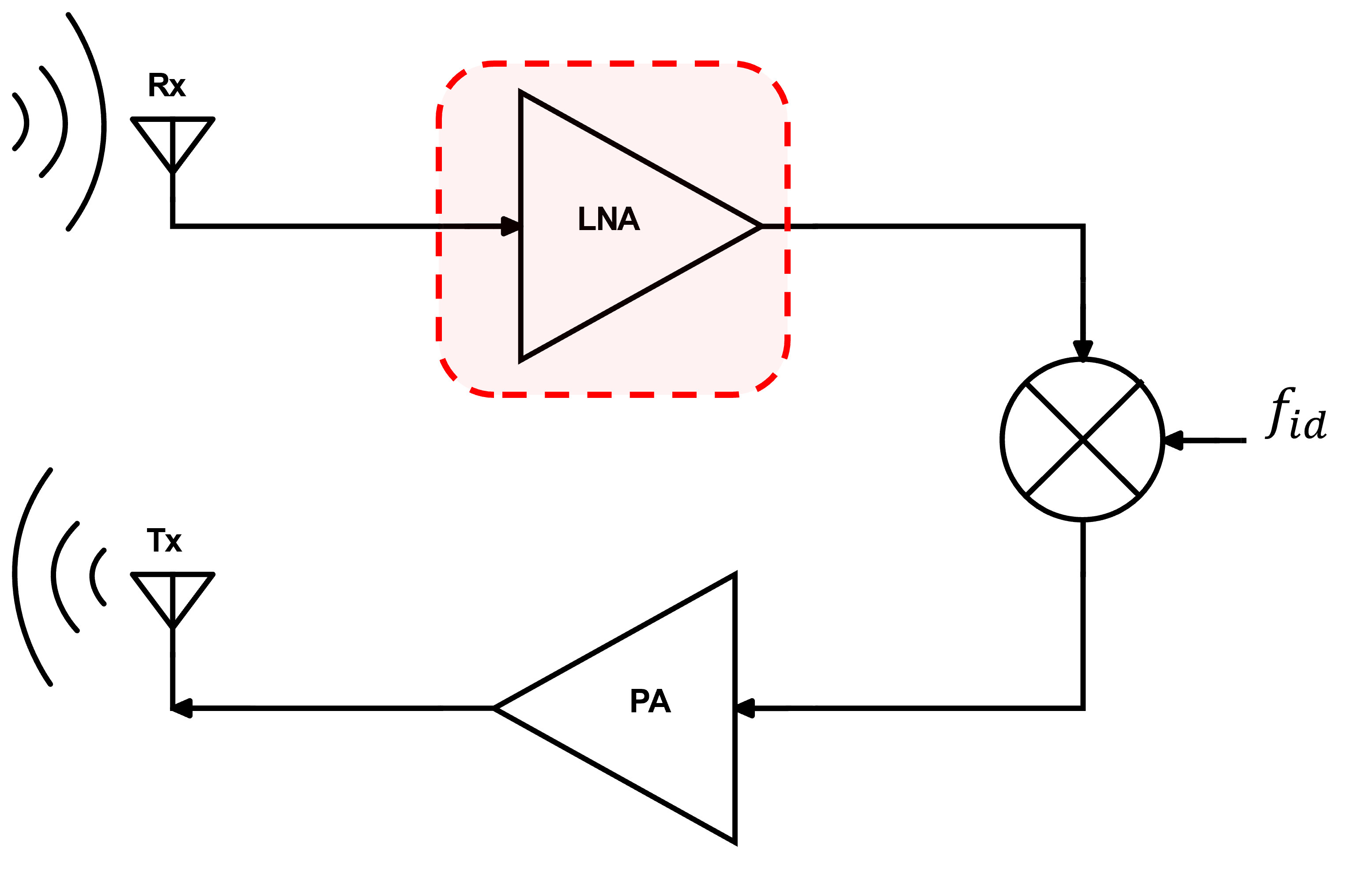
Radar sensors are widely used in a variety of engineering applications. Active radar tags are utilized to estimate the range and velocity of objects, as well as to obtain localization and environmental information. Doppler tags further add object identification feature by modulating the radar signal with an emulated Doppler signal. This thesis work focuses on the first block of the receiver front-end design of an active Doppler tag operating at 60 GHz.
The core task is the design and layout of a Low Noise Amplifier (LNA), which is the first block of the receiver chain. The design comes with challenges due to the trade-offs among low noise figure, high power gain, and low power consumption. The performance metrics must be optimized to achieve a high dynamic range and ensure robustness against desensitization.
Tasks
- Conduct research on low-noise amplifier (LNA) topologies, stability-enhancement and noise cancellation techniques.
- Design, analyze, and compare core topologies to optimize impedance matching, noise figure (NF), gain, and stability.
- Implement the core transistor designs into a schematic-level amplifier. Design and analyze the input and output matching networks. Perform S-parameter, noise, stability, and large-signal simulations to evaluate and optimize the circuit performance.
- Create the layout of the complete amplifier, including matching networks and RF pads. Run EM simulations on the passive structures and perform post-layout simulations. Optimize the layout to meet the target performance achieved at the schematic level.
- Investigate the impact of packaging (e.g., bond-wire simulation) on overall LNA performance.
- Compare the final results against state-of-the-art designs in the literature.
Requirements
- Understanding of electronic circuits and passive devices.
- Knowledge of the operating regions of MOSFETs and BJTs.
- Familiarity with S-parameter and large-signal analysis.
- A solid background of Electronic Circuits (ES), and RF Electronics (RFE) is essential. RFIC and MMIC are recommended.
- Experience with Keysight ADS and Cadence Virtuoso is advantageous.